
Most contractors aim to keep their cost of marketing at around 10%. That’s getting harder and harder to achieve with traditional lead gen channels alone.
Cold lead-gen — Google Ads, paid social, direct mail to strangers — can cost 25–35% of the revenue it produces. That’s the industry benchmark, and it’s the channel most contractors over-invest in.
Repeat and referral business from your own past customers? That’s the real gold mine.
Those are the warm leads that convert to sales at higher rates with the right systems in place. Next Door and Window, a window and door replacement company serving Chicago, St Louis, and Madison, has a less than 2% combined cost of marketing on repeat and referral business.
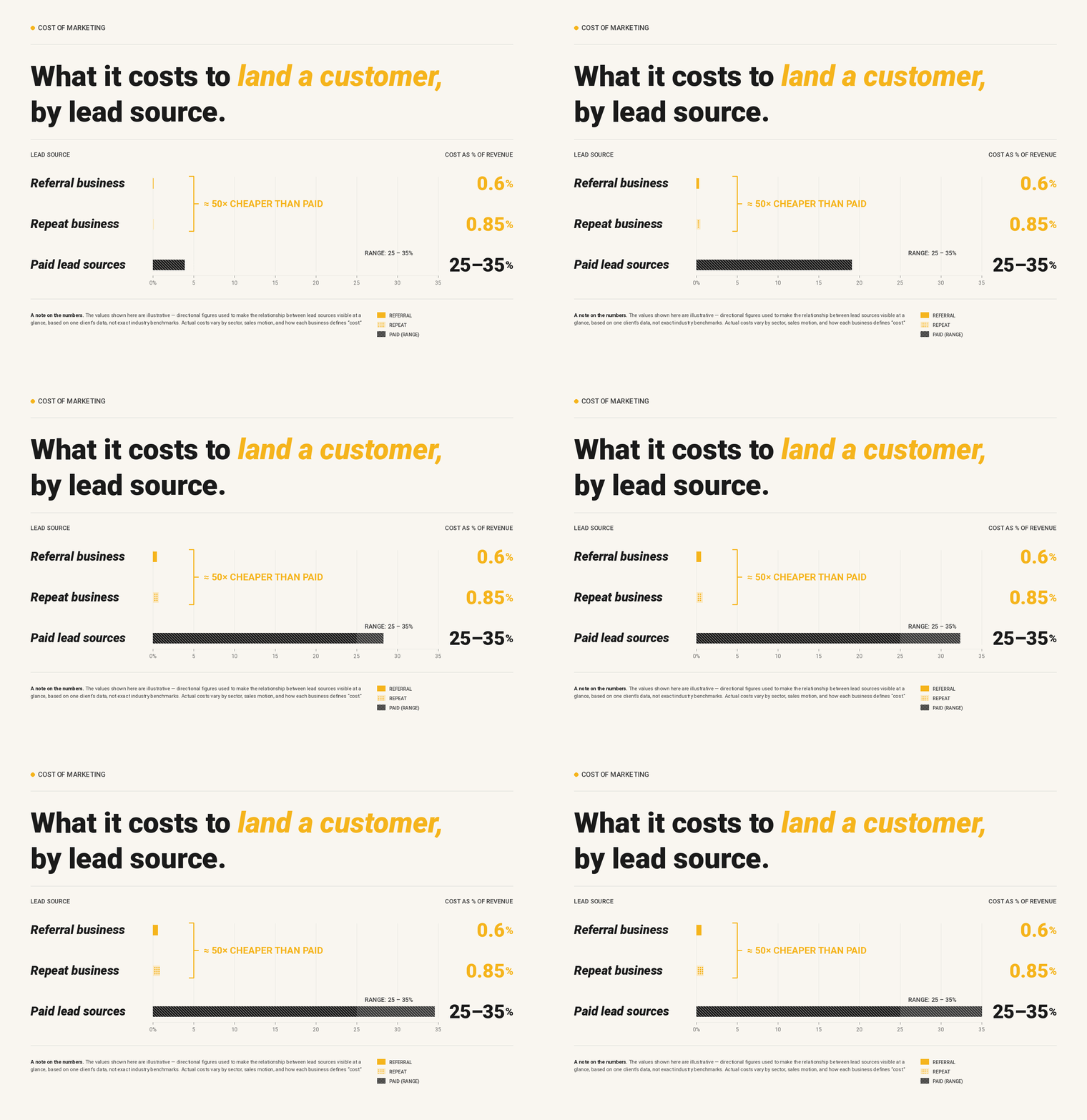
That’s more than 10 times the marketing cost on one side. Most contractors never sit down and actually run that math, so they keep optimizing the expensive channel and ignoring the one with the highest profit potential.
Let’s run the math by business size.
Repeat and referral revenue tends to get bucketed under “good work” or “luck.” But with the right systems in place, it can be a reliable revenue source.
When we surveyed 100 home improvement contractors, 73 said they weren’t getting enough of it. But 65 said the same thing about why: they don’t have the bandwidth to keep up with it.
It’s a quantifiable line item — but when you don’t measure it, you under-invest in it. That’s exactly what’s happening across the industry.
The good news: this isn’t fuzzy.
If you know three numbers about your business, you can model what a relationship marketing system could produce for you.
How much money are you really leaving on the table by not investing in relationship marketing? We’re talking customer appreciation, online reviews, and reputation management, referral rewards programs, and customer nurture campaigns.
To really understand the potential ROI and what you could win, you need to answer these three questions:
Each one moves the calculation differently. Annual revenue gives you your average ticket. Job volume tells you how fast your customer database is growing. Your CRM size tells you about the dormant base — the customers who have already paid you once and could pay you again.
A $2M contractor with 20 jobs a month and 800 customers in CRM looks very different from a $10M contractor with 40 jobs a month and 4,000 customers in CRM. Same system, different scale. Same close rates, very different revenue numbers.
Different sub-industries are going to have different numbers, but here’s the one thing they all have in common:
Implementing a relationship marketing system can increase ROI by tapping into your existing customer database.
These numbers aren’t arbitrary. We can calculate them because we’ve looked at 17 years of data and benchmarked ROI trends from contractors across subindustries.
We could show you sample numbers, but why not see what the outcome is for your business? Plug your numbers into our ROI calculator to see what this would look like for your company. These are illustrative — your actual numbers will differ based on average ticket and your existing referral baseline.
The math is built on the higher close rates our team sees consistently on repeat and referral appointments across the program. That’s not a forecast — that’s what’s actually happening for the contractors who have a system in place.
Compare that to cold lead close rates — typically single digits to low double digits — and the cost-of-marketing gap becomes the entire story.
The calculator output is an estimate of how you would win with the gFour system.
But contractors in the gFour program have been winning repeat and referral revenue since 2009.
One gutter company booked 76 repeat jobs worth more than $700K in their first year with us.
A $6M roofing member had about 2,800 dormant past customers sitting in their CRM. We ran a database reactivation campaign. Within three months, 94 customers came back — a 3.5% conversion on a list they already owned.
Another contractor generated $1M in revenue in 3.5 months by rehashing 898 unsold leads — leads they’d already paid to acquire and let go cold.
A single seasonal mailer drove $120K in repeat revenue for one client. The campaign cost about the same as a handful of TV leads.
Across the platform, the median ROI is 14x after 12+ months. Returns compound the longer contractors stay in the system.
The three-question framework above isn’t a throw-away script — it’s a real conversation about your business. When you give us your revenue, job volume, and CRM size, we plug those numbers into the same model you’re using and show you what the gFour relationship marketing system would do for your business.
What we usually hear next: “I had no idea it was that much.”
That’s the gut-check moment. Once a contractor sees the dollar figure attached to revenue they’re not activating, the rest of the conversation changes. It stops being a marketing decision and starts being a math decision.
Two things contractors usually want to know at that point:
Honest answers:
Our members have a smooth experience with great results. That’s why so many stay with us for a decade-plus — 99% client retention isn’t an accident.
You don’t have to take our word for any of this. Run the numbers yourself.
Two ways to do it:
If your math says you’re leaving six or seven figures of repeat and referral revenue on the table — and for most contractors at $2M+, it does — the question stops being “should we do this?” and starts being “how soon can we start?”
Want to run these numbers for your actual business? Plug your jobs, ticket size, and customer base into the gFour ROI calculator at gfourmarketing.com — it takes about two minutes. Or book a strategy call, and we’ll walk through it with you. No pitch, just the math.

Stay updated with our latest Blog Posts

Homeowners search reviews before hiring a contractor, and Google has always rewarded that. Now AI answers like ChatGPT do too, and here’s what to do about it. Data shows that
Read More
Don’t wait for leads to dry up in the off-season. The relationship marketing systems you build during peak season are what weatherproof your lead pipeline. By the end of this
Read More
Run the real numbers on your repeat and referral revenue. See what contractors across sub-industries with varying ticket sizes and job volumes leave on the table. Most contractors aim to
Read MoreSchedule an appointment or consultation with us today to get started.
Book an Appointment